南北戦争のとき自分の楽隊とともに北軍第24マサチューセッツ歩兵連隊に徴用された指揮者パトリック・サースフィールド・ギルモア(Patrick Sarsfield Gilmore)は、
ルイジアナ州の楽隊を再編成するよう命じられた1863年、
酒盛りの歌 “Johnny Fill Up the Bowl” のメロディにルイス・ランバート(Louis Lambert)名義で新たな詞をつけ(作曲もしたと主張)、楽譜をボストンのヘンリー・トールマン社から出版しました。
それが “When Johnny Comes Marching Home”(邦題=ジョニーが凱旋するとき/ジョニーが帰るとき)という曲です。
歌詞からすると、そのときギルモアは南軍と北軍の和解を意図していたのかもしれません。彼はのちにジョン・フィリップ・スーザとともにアメリカン・バンド(アメリカ軍楽隊)の父と呼ばれたそうですから、向こうじゃかなりの有名人だったようです。
1800年代前半からアイルランドで歌われていたという(対イギリス戦争)反戦歌 “Johnny I Hardly Knew Ye” のメロディがほぼ同じものでしたので、私はそちらが元歌ではないかと思っていました。
トラディショナル・ソング(伝承歌、古謡、民謡)に別の題名と詞をつけて著作権を主張する事例はあまた存在し、
例えば ポール・サイモンがイングランド民謡『スカボロー・フェア』を自作とクレジットしたのと、これは同じパターンだろうと。
しかしそれは間違いだったようです。
“Johnny I Hardly Knew Ye” はもともとは違うメロディーで、あとから “When Johnny Comes Marching Home” のそれに合わせて歌われるようになったとか。
ただ、当のギルモア自身が1883年、ミュージカル・ヘラルド紙の記取材に対し、「南北戦争の初期に誰かが口ずさむのをたまたま聞き、それを書き留め、ドレスアップし、題名を付けた。 そして、時代にふさわしい特別な目的のためにそれを有用に韻を踏んだ」と、自作でないことをシレッと白状してる事実があります。
歌詞については伝承歌はバリエーションがあるのが普通ですから改作・新作大いに結構、それは許されると思うのですが、メロディまで自作として出版するのは、今だったら「自分、モロ、パクリちゃうんか?」と云われそうです。
そして以下の記述によると、メロディのルーツはさらに遡るようです。
The original sheet music for “Johnny Fill Up the Bowl” states that the music was arranged (not composed) by J. Durnal.
There is a melodic resemblance of the tune to that of “John Anderson, My Jo” (to which Robert Burns wrote lyrics to fit a pre-existing tune dating from about 1630 or earlier), and Jonathan Lighter has suggested a connection to the 17th-century ballad “The Three Ravens”.「ジョニー・フィル・アップ・ザ・ボウル」のオリジナルの楽譜には、音楽はJ・ダーナルによって編曲された(作曲ではない)と記載されています。
この曲は「ジョン・アンダーソン、マイ・ジョー」(ロバート・バーンズが1630年頃以前の既存の曲に合わせて歌詞を書いた)の曲にメロディックに似ており、ジョナサン・ライターは17世紀のバラード「三羽のカラス」との関連性を示唆している。<When Johnny Comes Marching Home – Wikipedia>
https://en.wikipedia.org/wiki/When_Johnny_Comes_Marching_Home
- 世界の民謡・童謡 > 世界の民謡 > アメリカ > ジョニーが帰るとき(ジョニーの凱旋)
- 七洋艦隊:船上楽隊:When Johnny Comes Marching Home ジョニーが凱旋するとき
- SYU’S WORKSHOP:『ジョニーが凱旋するとき』について
- American Memory from the Library of Congress(”When Johnny Comes Marching Home”を検索すると文献が出る)
- When Johnny Comes Marching Home – Wikipedia, the free encyclopedia
- Johnny I Hardly Knew Ye – Wikipedia, the free encyclopedia
まずは私が元唄と勘違いした “Johnny I Hardly Knew Ye” 聞いてみましょう。
最初のレコード化が誰なのか不明ですが、新しいところで(!)ボブ・ディランの録音が残ってます。
『スカボロー・フェア』の詞を『北国の少女』のネタ元にしてたディランですが、この歌はさすがに自作とは主張してないようです。
●Bob Dylan – Johnny I Hardly Knew You(1960)
from 2×CD, Unofficial Release “Ten Million In A Week”(2007)Hollow Horn
Minnesota Party Tape, Minneapolis – September 1960
●Bob Dylan – Johnny I Hardly Knew Ye(1960)
from 4×CD, Unofficial Release “From Minnesota To New York 1958 – 1961″(2009)Wonderland Records WLR-2120
- Janis Ian – Johnny I Hardly Knew Ye
- The Clancy Brothers – Johnny I hardly Knew Ye
- De Dannan & Mary Black – Johnny I Hardly Knew Ye
- Wolfgang Plaschke – Johnny I hardly Knew Ye(Folkbeat 2009 Neumünster)
- Raymond Crooke – Johnny I Hardly Knew Ye
- Dropkick Murphys – Johnny I Hardly Knew Ye
- The Irish Rovers- Johnny I Hardly Knew Ye
- The Tossers – Johnny I Hardly Knew Ye
- Karan Casey – Johnny I Hardly Knew Ye
今度はパトリック・ギルモアの採譜と歌詞による『ジョニーが凱旋するとき』。
基本的には進軍歌、マーチの体裁ではあります。
U.S. Military Academy Band – When Johnny Comes Marching Home
“When Johnny Comes Marching Home” は第二次世界大戦のときもグレン・ミラー楽団のスイング・バージョンで蘇りました。
「ジョニー」はこのときすでに南軍の少年兵ではなくアメリカの兵士全体の象徴となっていました。
Glenn Miller and his Orchestra – When Johnny Comes Marching Home(1942)
(adapt: Conway-Dickinson-Finnegan)
vocal: Tex Beneke, Marion Hutton, and The Modernaires
recorded in NYC February 18, 1942
Andrews Sisters* with Vic Schoen And His Orchestra – When Johnny Comes Marching Home(1942)
SP盤 “East Of The Rockies” のB面。
アメリカ映画『第十七捕虜収容所(Stalag 17)』(1953)
When Johnny Comes Marching Home Again
テレビドラマ『コンバット!』のテーマ曲が『リリー・マルレーン』の変奏であることはよく知られておりますが、それだけでは片手落……もとい、正確ではありません。正しくは、民主主義のために闘うアメリカ兵を象徴するところの『ジョニーが凱旋するとき』およびそれを元にしたモートン・グールド作曲の『アメリカン・サリュート』と、ドイツ兵の人間性を象徴する『リリー・マルレーン』の、その双方をミックスした、和合させたのが『コンバット!』のあの曲であったというべきでしょう。
Lale Andersen – Lied eines Jungen Wachtpostens(Lili Marlen)(1939/11 original German version)
Vortragslied mit Orch.
Electrola Gesellschaft m. b. H., Berlin
Record Company: Electrola Gesellschaft m.b.H.
Conductor: Bruno Seidler-Winkler
Written-By: Hans Leip, Norbert Schultze
recorded August 2, 1939
The original 78rpm single was issued on (Germany) Electrola E. G. 6993
Popular with both the German and Allied WWII troops–and first issued under the title “Lied eines Jungen Wachtpostens” (Song Of A Young Sentry)–this original German-language recording by the German singer-songwriter became one of the more historically significant commercial music discs ever made.(she later also recorded an English-language version).
The fascinating and complex tale behind the song–and this version in particular– is interestingly related in the 2008 book “Lili Marlene: The Soldiers’ Song of World War II,” or you might just check the “Lili Marleen” entry in Wikipedia. See also the 1944 American-made recordings by both Hildegarde and Perry Como.
Hildegarde – Lili Marlene(1944)
orchestra and chorus conducted by Harry Sosnik
The fascinating and complex tale behind this historically significant song is interestingly related in the 2008 book “Lili Marlene: The Soldiers’ Song of World War II,” or just check the “Lili Marlene” entry in Wikipedia.
Perry Como – Lili Marlene(1944)
with Mixed Chorus
Marlene Dietrich – Lili Marlene(1945 English Version)
Directed By: Charles Magnante
recorded in 1944
“Lili Marleen” (also known as “Lili Marlene”, “Lily Marlene”, “Lili Marlène” and similar variants) is a German love song which became popular during World War II with soldiers of both sides.
Written as a poem in 1915, during World War I, it was published under the title “Das Lied eines jungen Soldaten auf der Wacht” (German for “The Song of a Young Soldier on Watch”) in 1937 and was first recorded by Lale Andersen in 1939 under the title “Das Mädchen unter der Laterne” (”The Girl under the Lantern”).
Following the Nazi invasion of Yugoslavia in 1941, Radio Belgrade became Soldatensender Belgrad and played the song frequently to entertain the German armed forces within its reach. It became popular throughout Europe and the Mediterranean among both Axis and Allied troops.
In 1944, the Morale Operations Branch of the U.S. Office of Strategic Services (OSS) initiated the Muzak Project, musical propaganda broadcasts designed to demoralize enemy soldiers. Marlene Dietrich, the only performer who was made aware that her recordings would be for OSS use, recorded a number of songs in German for the project, including Lili Marleen.
Marlene Dietrich – Lili Marlene(Deutsch Live)
from the album “Lili Marlene – Sung In German”(1959)Columbia CL 1275
Anita Lindblom – Lili Marlene
in Swedish
from the album “Anita”(1975)Marilla MALP-59
US Air Force Concert Band & Singing Sergeants – Morton Gould: American Salute
作曲:1942年
- 吹奏楽マガジン Band Power:富樫鉄火の吹奏楽曲でたどる世界史【第40回】アメリカン・サリュート ~「ジョニーが凱旋する時」による
- Morton Gould – Wikipedia, the free encyclopedia
- モートン・グールド – Wikipedia
- So in Love more register movement
アメリカABCテレビドラマ『コンバット!(COMBAT)』Intro
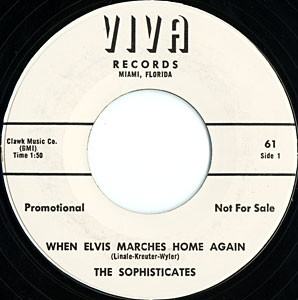 手元に面白いレコードがあります。
1959年6月、フロリダの Viva Records からリリースされたザ・ソフィスティケイツ(The Sophisticates)というグループの『When Elvis Marches Home Again』(右)。
エルビスの入隊に関連した便乗ソングの一つで、『ジョニーが凱旋するとき』の替え歌になってます。
ただ、ちょっとヒステリックで、ファンのスクリーミング(甲高い悲鳴、金切り声)を代弁してるかのような雰囲気。曲調も深刻ですから、只事じゃねーなーという感じです。
ソウル系ガールグループに同名の人たちがいますが、それとは無関係と考えられます。
<参考リンク ガールグループのザ・ソフィスティケイツ>
- The Sophisticates – Can’t Move No Mountains(1972)
- The Sophisticates – Back Up Baby(1969)
- The Sophisticates – I Really Hope You Do
- The Sophisticates – I Need You
ピーター、ポール&マリーの『悲惨な戦争(The Cruel War)』(1962)で歌われる恋人の名はジョニーで、応召した彼が向かう戦場がどこかは詞に出てきません。
全体 恋人の後を追って行きたいという心情の吐露でして、映画『モロッコ』のラストシーンを連想させます。反戦歌というより、やはりこれはラブソングでしょうね。
同じく彼らの『虹と共に消えた恋(Gone The Rainbow)』(1962)では各コーラスの最後が “Johnny’s gone for a soldier.” となっています。
Peter, Paul and Mary – Gone the Rainbow(1962/07)虹と共に消えた恋
シングル “If I Had A Hammer(The Hammer Song)” のB面。
from the album “(Moving)”(1963/03)
<参考>
Cleo Laine – Waiting For Johnny To Come Home(UK:1962/02)
<参考>
The Travellers – Buttermilk Hill(Canada:1963)
<参考>
Mark O’Connor and James Taylor – Johnny Has Gone for a Soldier
Mark O’Connor
2014/03/17 に公開
シャングリラスの1966年2月のヒット『涙の祈り』の冒頭と終り近くで、『ジョニーが凱旋するとき』が短く引用されています。この歌の時代に恋人たちを引き裂いていたのはベトナム戦争でした。
The Shangri-Las – Long Live Our Love(1966/01)涙の祈り
produced by Shadow Morton
Pop Chart Peaks: Billboard 33, Cash Box 35, Record World 38
Final top-40 hit for the quartet from Queens.
『ビートでジャンプ』『マッカーサー・パーク』『恋はフェニックス』『ウィチタ・ラインマン』等で有名なジミー・ウェッブ(Jim Webb)の手になるこちらの作品もベトナム戦争を背景としたもの。
Mary Kent – Lost Generation(1969)
Joe Tex -(When Johnny Comes Marching Home Again)I Can’t See You No More(1970)
タイトルを借用した例。
- Mitch Miller – When Johnny Comes Marching Home
- Per-Erik’Pärre’ Förars – Yö Preerialla(1959)
- Adam Faith – When Johnny Comes Marching Home
- The Sheppards – When Johnny comes marching home(1967)
- Petula Clark & Peggy Lee – When Johnny comes marching home
- The Chipmunks – When Johnny Comes Marching Home
- The Clash – English Civil War(Johnny Comes Marching Home)
- The Fightin’ Texas Aggie Band – When Johnny Comes Marching Home
映画『ダイ・ハード3』(1995年)では悪党が大仕事をするところで『ジョニーが凱旋するとき』が使われます。この例では、軍事作戦をイメージさせる選曲意図が感じられます。
『ジョニーが凱旋するとき』の歌と直(じか)に結びつくものではありませんが、1971年、アメリカで『ジョニーは戦場へ行った(Johnny Got His Gun)』という映画が作られています。
これはドルトン・トランボ(今はダルトン・トランボの表記が多い)が1939年に発表した小説『ジョニーは銃をとった』を、自ら脚色し監督した作品で、第一次大戦のヨーロッパ戦線において両手、両足、耳、眼、口を失い、病院で秘密裏に『生かされている』若きアメリカ兵の、惨憺たる境遇、心の地獄を描いています。小説とはいえ、実在のモデルがいたといいますから、なんとも空恐ろしい話です。
日本初公開時に劇場で見ているせいか、ジョニーがどうしたとか聞くと、私はいつもこの映画のことが頭に浮かんできます。
設定が類似している江戸川乱歩の短編『芋虫』(発表時タイトルは『悪夢』)は1929(昭和4)年ですからトランボの小説より早いですね。
- Johnny got his gun – Original Trailer
- Johnny Got His Gun – DVD Trailer
- Johnny Got His Gun (2008)
- ジョニーは戦場へ行った Johnny Has Gone for a Soldier | 世界の民謡・童謡
追加記事
力強い反戦映画と評価=若松監督『キャタピラー』-独紙
【ベルリン時事】ベルリン国際映画祭で最高賞『金熊賞』を争うコンペティション部門に出品された若松孝二監督の『キャタピラー』について、ドイツ紙ボルケナー・ツァイトゥングは16日、『力強い反戦映画』と評価した。
同紙は、これまで映画祭で上映された作品の中で『最も政治的な映画』と指摘。『監督があらゆる戦争を批判しているのは明確だ』と伝えた。(2010/02/16-21:42)
http://www.jiji.com/jc/zc?k=201002/2010021600844
四肢を失った主人公という設定は、映画化もされた『ジョニーは戦場へ行った』や江戸川乱歩の小説『芋虫』など、これまでにも登場してきたものだが、若松監督は「実は12日間で撮っているんですよ。『実録・連合赤軍あさま山荘への道程(みち)』でかかったお金がまだ穴埋めできていない。それでも、気持ちがさめないうちに作りたかった。戦争では、女性や子ども、普通の人々が一番の被害者だということを少ない予算で表すのに、こういう形になった」
http://movies.jp.msn.com/news/article.aspx?articleid=228095
乱歩『芋虫』の映画化じゃないようです。マジで反戦映画? 若松孝二が?
(2010年2月21日)
追加記事
The Clash – English Civil War(1979)
ザ・クラッシュ – イングリッシュ・シヴィル・ウォー(英国内乱)
(2012年3月3日)
追加記事
キャタピラーの正式名称→「無限軌道」 キャタピラーは商品名。 http://t.co/Lc5UsXcHAj
— 例のアレの名称bot (@meisho_bot) 2014, 7月 8
(2014年7月8日)
追加記事
スタンリー・キューブリック脚本・監督『博士の異常な愛情 または私は如何にして心配するのを止めて水爆を愛するようになったか』(Dr. Strangelove or: How I Learned to Stop Worrying and Love the Bomb)(1964)
で使われている『ジョニーが凱旋するとき』。
The Bomb Run Sequence from Dr. Strangelove
Dr. Strangelove (7/8) Movie CLIP – Kong Rides the Bomb (1964) HD
(2015年3月21日)
追加記事
Paul Anka – My Baby’s Comin’ Home(1964/04)
RCAビクター移籍後の録音。作曲・作詞は Anka-Butler の表示。
(2015年4月12日)
追加記事
Ireland in the Revolutionary Period – A selection of Irish Footage in the British Pathé archive
This “selection of Irish Footage in the British Pathé archive” gives a taste of some of the finest contemporary reporting on the Irish Easter Rising (1916), War of Independence (1919-1921) and Civil War (1922-1923). The piece finishes with a brief look at the declaration of the Republic (1949). Filmed largely before the age of cinema sound, this footage is silent.
サイレントの映像「革命時代のアイルランド」
蜂起に至るまでの長い長い歴史、数々の出来事を知らないと、『ジョニーが凱旋するとき』を理解できないかも。
(2016年1月23日)
追加記事
The Ants Go Marching | Kids Songs | Super Simple Songs
Super Simple Songs – Kids Songs
2017/05/27 に公開
(2017年5月28日)
追加記事
似た邦題でこちらの歌も有名ですね。
日本では 故 石井好子さんが得意とされてました。
Yves Montand – Quand un soldat(1953)
イヴ・モンタン – 兵隊が戦争に行くとき
Francis Lemarque – Quand un soldat(1952)
フランシス・ルマルク – 兵隊が戦争に行くとき
オリジナル・レコーディング?
(2016年3月21日)
追加記事
日曜日も終わろうとしてますね。
Dr.ストレンジって言えばlove 、しかもキューブリックですよ。
シュールなコメディ映画の最高峰です。
印象深いのは、ジョニーが凱旋するときのフレーズの入ったマーチが
あるからでしょう。パクリも結構あるほど、琴線に触れるメロです☺️ pic.twitter.com/mJAdTbT56N— Ohtakeiichi (@whispering44) November 13, 2022
(2022年11月14日)
追加記事
コンバット
レナード・ローゼンマンの
2012年「初音盤化」されたレア
TVサウンドトラック集 https://t.co/Gj0Ly4Jlb9 @YouTubeより pic.twitter.com/95eKGvhZq0— Brasil678 (@tm05437) October 25, 2024
(2024年10月25日)